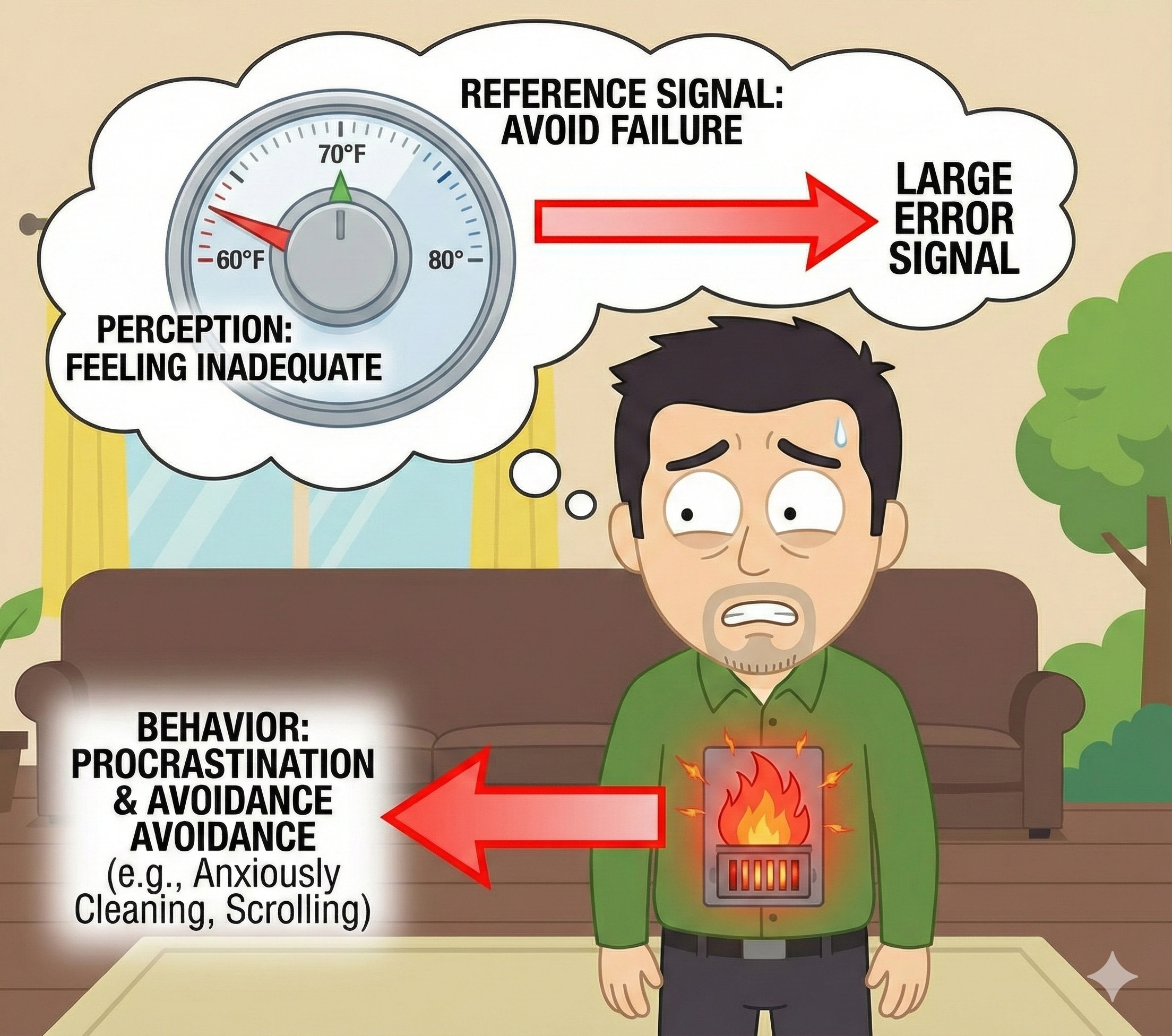
Have you ever had a "breakthrough" in therapy where you intellectually understood your problem, yet the behavior didn't change? You knew you shouldn't feel anxious, but your heart raced anyway. You knew you were procrastinating, but you couldn't make yourself work.
This gap between knowing and being is the final frontier of modern personal growth.
To bridge it, we need to look at a fascinating convergence between two powerful frameworks: Perceptual Control Theory (PCT) and the neuroscience of Memory Reconsolidation (often associated with Bruce Ecker’s Coherence Therapy). While they use different languages, they are describing the exact profound mechanism: how to rewrite the "code" that runs your life permanently.
Traditional psychology often views behavior as a reaction to a stimulus (something happens, and we react). Perceptual Control Theory (PCT) flips this on its head. It argues that behavior isn't a reaction; it is a way to control our perception of the world so it matches our internal standards.
Think of a thermostat in your home:
We operate the same way. We don't act because of what happens to us; we act to keep our internal world matching our internal standards.
In therapy, we often talk about Core Beliefs (CBT), Schemas (Schema Therapy), or Worldviews. In PCT, these deep-seated scripts are simply high-level Reference Signals.
If you have a Reference Signal that says, "I must be perfect to be loved," your "perfectionism" isn't a disorder. It is the furnace kicking on to meet that setting. It is the system working precisely as it was designed.
If behavior is just about keeping our perceptions in line with our references, why do we get stuck? Why do we keep "settings" that make us miserable, like anxiety or depression?
This is where the concept of Memory Reconsolidation and Bruce Ecker's Coherence Therapy offer the missing piece.
Ecker argues that we never hold on to a negative behavior unless it successfully solves a problem or serves a function for us. This is called the "Pro-Symptom Position."
For example, you might consciously want to stop people-pleasing. But unconsciously, you hold a Reference Signal that says: "If I say 'no', I will be abandoned."
As long as that Reference Signal is active, no amount of willpower or positive thinking will stop the people-pleasing. Your internal thermostat is set to "Avoid Abandonment," and people-pleasing is the only way your brain knows to maintain that sense of safety.
So, how do we change settings that were often locked in during childhood?
PCT tells us that the brain rewires itself through a process called Reorganization. This is a trial-and-error learning mode that is triggered only when the system encounters a persistent error it cannot resolve.
To trigger this, we need what Ecker calls a Juxtaposition Experience. We must activate the old neural pathway (the Reference Signal) and simultaneously expose it to a reality that contradicts it.
In that exact moment, the brain experiences a massive "Error Signal" (in PCT terms). The perception (warmth) violently clashes with the reference signal (expectation of hurt).
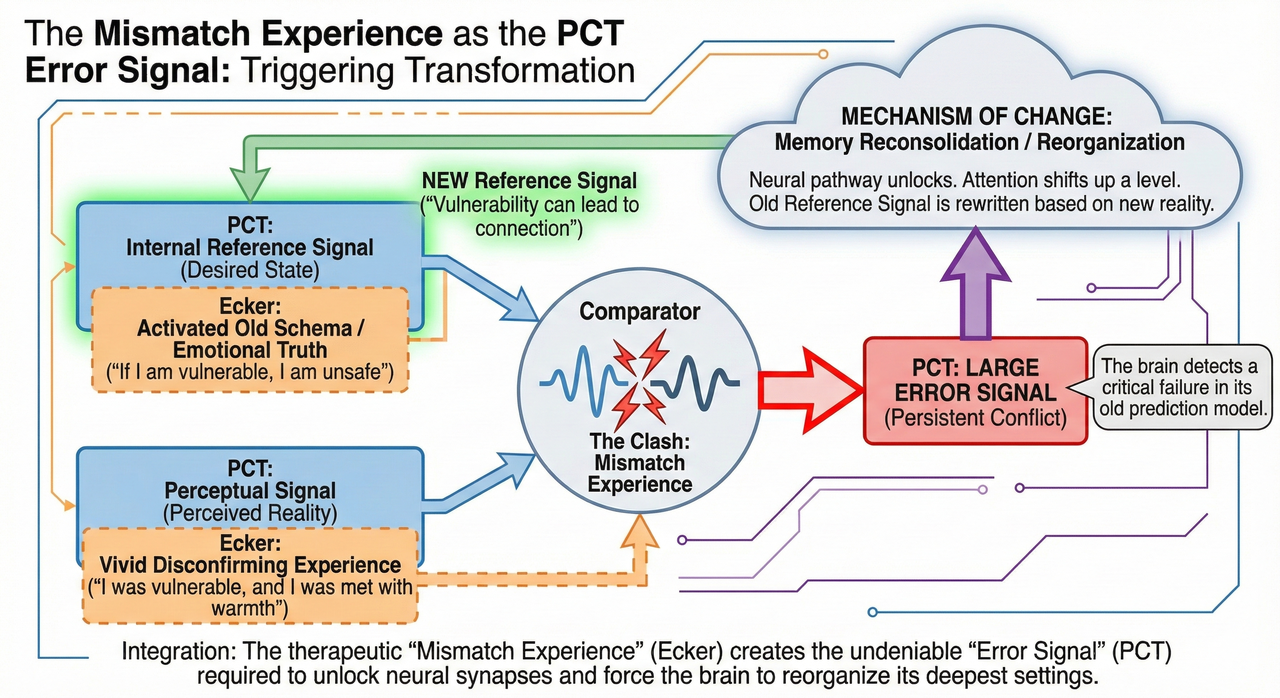
When this clash happens, the synapses holding the old memory unlock. The system realizes that the old control loop is invalid. Attention moves "up a level," and the neural weights are rewritten. The thermostat is finally reset.
To see how this looks in practice, let’s look at a dialogue using the Method of Levels (MOL), the therapeutic application of PCT.
Client (Alex): "I just can't get myself to sit down and write. I end up cleaning the house or scrolling through my phone. I think I’m just self-sabotaging because I'm lazy."
Therapist: "You mentioned feeling like you're just being lazy. When you say that word, 'lazy,' what comes to mind right now?"
Alex: [Sighs heavily and looks down at his hands] "Just... disappointment. Like I’m wasting my potential."
Therapist: [Noticing the disruption—looking down] "I noticed you looked down at your hands just as you said 'disappointment.' What was happening for you just then?"
Alex: "I don’t know. I just had this flash of... my dad. He used to stand over me while I did homework. If I got an answer wrong, he’d get this quiet look of... 'I expected better.'"
Therapist: "As you picture that look now, what thoughts are hovering in the background?"
Alex: "That look is terrifying. It makes me want to disappear."
Therapist: "And when you think about sitting down to write your book now, how does that relate to 'disappearing'?"
Alex: [Pauses. Eyes widen.] "Whoa. If I don't write, there's nothing to read. If there's nothing to read, there's nothing to judge."
Therapist: "So, keeping the page blank keeps you safe?"
Alex: "Exactly. If I don't try, I can't fail. I’m controlling the situation so I don't have to feel that shame."
Therapist: "How do you feel about the 'laziness' now, seeing it as a shield rather than a flaw?"
Alex: "I feel... less angry at myself. It actually makes sense. I’m not broken; I’m protecting myself."
In this moment, Alex moved "Up a Level." He moved from fighting the behavior (procrastination) to seeing the Reference Signal causing it (Safety from Judgment). Once he saw the conflict, his brain could begin to reorganize.
You don't always need a therapist to start catching your own reference signals. The next time you feel "stuck" or find yourself doing a behavior you dislike, try these self-inquiry questions:
We behave as we do to satisfy our internal settings—our Reference Signals. When we get stuck, it’s usually because we have a "coherent" reason for being stuck; our symptoms are protecting us from a danger our deeper brain perceives.
Transformational change doesn't come from fighting the behavior. It comes from honoring the reference signal (the need for safety) and then finding the mismatch—letting your brain see clearly that the old map no longer matches the territory.
When the error is clear, the brain essentially says, "Oh, this old code is buggy," and rewrites it for you.
If you would like to explore the science and theory behind these concepts, the following books are foundational texts for Perceptual Control Theory (PCT) and Memory Reconsolidation.


